
Homeschool Mastery Academy is dedicated to recommending quality resources to benefit homeschooling families. This blog contains and is monetized through sponsored posts and affiliate links. Please see our full disclosure policy for detailed information.
How to Homeschool Preschool at Home (Complete Guide)
If you are thinking about homeschooling your preschooler, you are probably feeling two things at once: genuinely excited about the idea and a little unsure where to even begin. That is completely normal. Starting preschool at home can feel like a big responsibility, especially when it is your first time. You want to do it right, but you are not quite sure what “right” looks like at this age.
Here is the thing most new homeschool parents quickly discover: preschool is less about formal academics and more about building foundational skills through play, routine, language exposure, and hands-on learning. Children at this age are not meant to sit at a desk for hours filling out worksheets. They learn by touching, doing, asking, and exploring.
That can be a challenge to wrap your head around, especially if you are used to thinking of “school” as something structured and lesson-based. But once you understand what preschool learning is really about, it becomes a lot less overwhelming and a lot more enjoyable for both you and your child.
Today we are walking you through everything you need to know to homeschool preschoolers confidently and create a flexible preschool homeschool routine that works for your family, no formal teaching experience required.
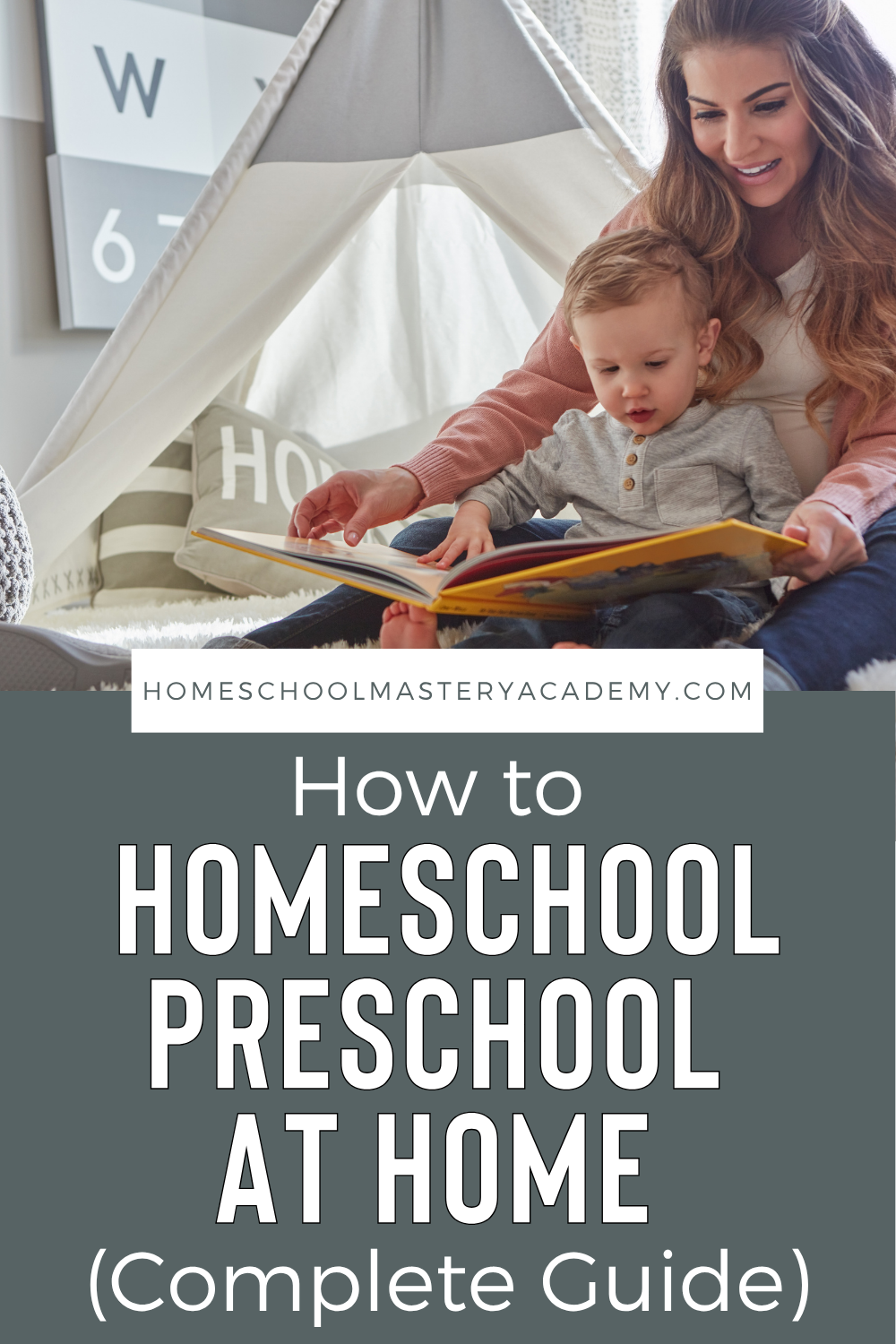
How to Homeschool Preschool at Home
Homeschooling preschool is not about replicating traditional school in your living room. It is about creating a playful, consistent, and nurturing learning environment at home where your child feels safe to explore and grow at their own pace.
Children in the preschool years learn best through repetition, interaction, and hands-on activities rather than structured academics. The goal is not to rush toward reading and writing milestones but to build the curiosity, confidence, and early childhood education foundation that makes those milestones come naturally later on.
Early childhood experts consistently point out that the majority of learning at this age should happen through play, movement, and exploration. Short, focused activities of 15 to 30 minutes are plenty. There is no need to fill hours with formal lessons, and in fact, trying to do so often works against young learners rather than for them.
The most effective approach is to start simple, stay flexible, and focus on building curiosity and confidence rather than chasing perfect outcomes. When you keep things low-pressure and consistent, you will be amazed at how much natural preschool learning happens in a single day at home.
Can You Homeschool Preschool?
Yes, and it is more straightforward than most parents expect. Preschool can be legally and effectively homeschooled in many regions, and in most places, preschool-age children are not yet subject to compulsory attendance laws. That means the regulations that apply to formal homeschooling typically do not kick in until kindergarten or first grade.
Because preschool is often less regulated than formal schooling years, families have a lot of flexibility in how they approach early childhood education at home. Many choose informal or play-based learning frameworks, while others prefer a loose preschool curriculum to provide more structure.
We always recommend checking the homeschool laws in your specific state or country before you begin, just so you have a clear picture of any requirements that may apply. But for most families, getting started with preschool at home is very accessible.

When To Start Homeschooling Preschool
There is no universal “right age” to start. The better question is whether your child is showing signs of readiness, and readiness looks different for every child.
Most children are developmentally ready for gentle preschool learning somewhere between ages 3 and 5, but that range is wide on purpose. A child who is cognitively ready at 3 might not have the attention span for even short activities yet, while another child at the same age might thrive with a simple daily rhythm.
The key is to start slowly with short, low-pressure activities rather than diving into a full structured schedule. Starting too formally too soon often backfires. When you follow your child’s natural curiosity and keep things playful, preschool learning tends to unfold in a much more sustainable way.
Signs your Child Is Ready For Preschool
Every child moves at their own pace, but here are some common signs that your child may be ready to begin some gentle preschool learning at home:
- Shows interest in books or stories
- Can follow simple two-step instructions
- Enjoys hands-on activities like building, drawing, or sorting
- Begins asking questions or naming objects in their environment
- Can engage in short, focused play sessions of 10 to 15 minutes
- Shows curiosity about letters, numbers, or how things work
What Do You Need For Homeschooling Preschool
One of the great things about preschool at home is that you do not need a lot of fancy materials to get started. Here are the basics:
- A simple daily rhythm or loose routine (more on this below)
- Basic art and craft supplies: crayons, paint, scissors, glue, construction paper
- A basket of books for daily read aloud time
- Manipulatives for counting and early math: counting bears, blocks, puzzles
- Sensory play materials: playdough, sand, water play
- Outdoor access for nature time and active play
- Open-and-go preschool curriculum if you prefer more guidance (see product links below)
If you are still in the early stages of thinking through materials and curriculum for the future, our guide on how to choose the best homeschool curriculum is a great place to start.

How To Create A Homeschool Schedule For Preschool
At this age, we do not recommend a rigid minute-by-minute schedule. What works far better is a predictable daily rhythm, a loose sequence your child can anticipate without locking everyone into a timetable that falls apart the moment something unexpected happens.
Think of it less like a school schedule and more like a Morning Menu: a simple collection of activities and rhythms you draw from each day. Some things happen most days, like read aloud time and outdoor play. Others rotate in based on your child’s interest and energy. The goal is consistency in rhythm, not rigidity in timing.
Here are some practical tips for building a daily routine that works:
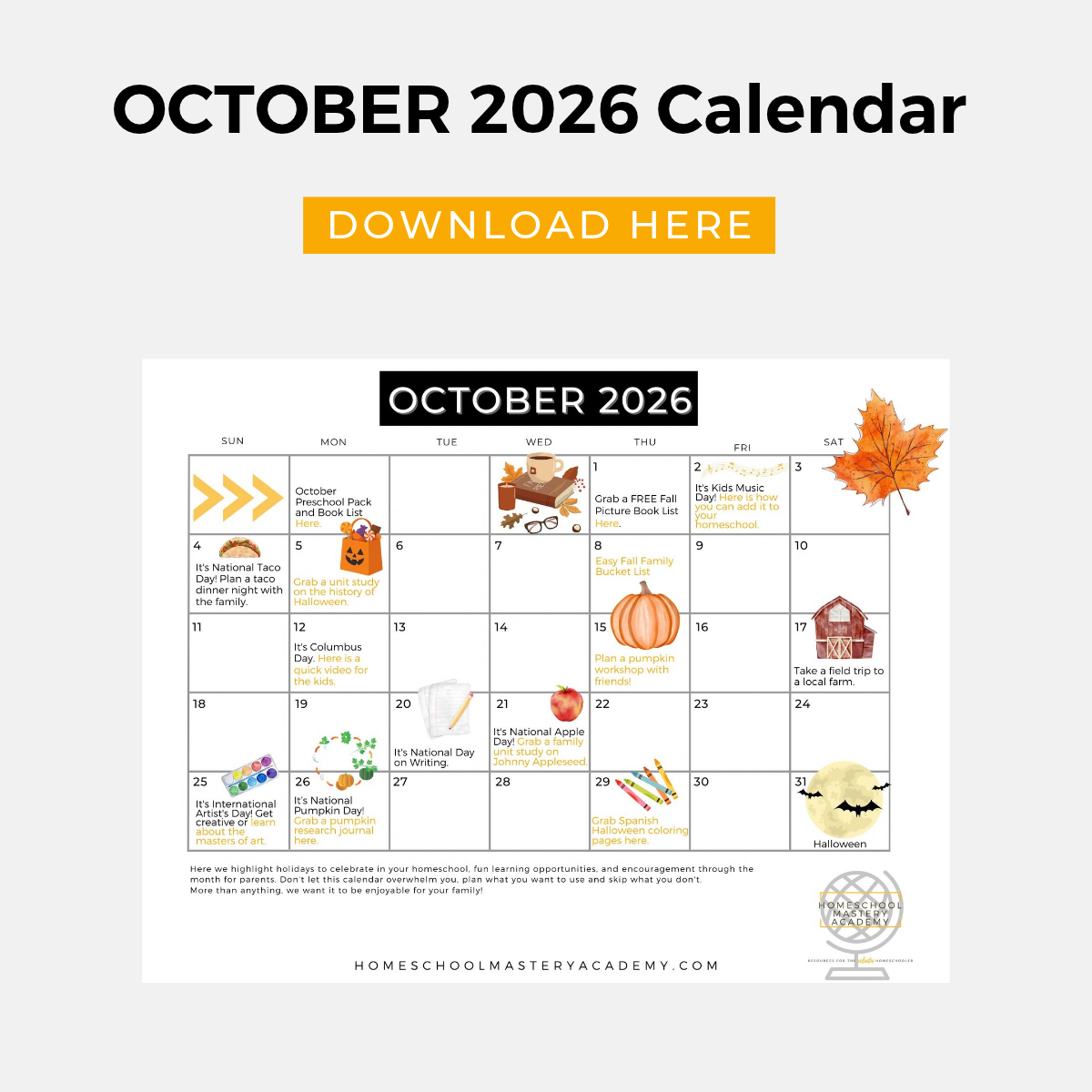
Keep a loose daily rhythm with 2 to 3 main learning blocks
Rather than scheduling every minute, identify 2 to 3 intentional learning windows in your day. This might be a morning circle time, a mid-morning activity block, and an afternoon read aloud. Everything else can flow naturally around those anchors. A loose rhythm gives your child the consistency they need without locking you into a rigid structure that is hard to maintain.
Limit activities to 10 to 20 minutes each
Preschoolers have short attention spans, and that is completely developmentally appropriate. Early childhood experts recommend keeping individual structured activities to around 15 to 30 minutes at most. Trying to push through a longer lesson will usually result in frustration for both of you. When you end on a positive note before your child loses interest, they are more likely to come back to learning with excitement the next day.
Read aloud every single day
If there is one thing we would put on every preschool family’s non-negotiable list, it is daily read aloud time. Reading aloud to your child is one of the most powerful things you can do for early language arts development. It builds vocabulary, listening comprehension, love of stories, and early literacy skills all at once, and it requires nothing more than a good book and a few minutes together. Make it a consistent part of your day, whether that is morning, after lunch, or before bed.
Count and explore with manipulatives
Hands-on math is the right math for this age. Counting bears, building blocks, coins, buttons, and everyday objects are all excellent tools for building early number sense. Let your child sort, count, arrange, and compare. These concrete experiences with manipulatives lay the groundwork for abstract math understanding later on, and they feel like play, because they are.
Make outdoor time part of the learning day
Outdoor time is not just a break from learning. For preschoolers, it is nature study, motor skills development, science observation, and physical activity all wrapped into one. A walk around the yard, time at the park, or simply playing outside counts. Point out bugs, plants, weather, and animals. Ask questions. Let your child lead. Research shows outdoor play is essential for healthy development at this age, and it is one of the easiest things to build into your day.

Include pretend play as a real learning activity
Pretend play is not just fun, it is one of the most developmentally rich things a preschooler can do. Playing house, running a pretend store, acting out stories, and taking on imaginative roles all build language, creativity, social understanding, and problem-solving skills. Do not underestimate it or try to replace it with structured learning. Our Preschool Pretend Play Bundle is designed to support this kind of open-ended imaginative learning with prompts and props your child will love.
Mix quiet tasks with active play
Young children need to move. If you follow a focused sit-down activity with something physical, like a sensory bin, outdoor play, or a gross motor activity, you will get much better engagement overall. Alternating between calm and active keeps energy levels balanced and makes the day feel more sustainable for everyone.
Repeat core skills throughout the week
Repetition is how preschoolers learn. You do not need a new activity every day. In fact, returning to the same songs, books, games, and concepts over multiple days is exactly how preschool learning solidifies. Rotate a small set of activities and skills throughout the week rather than introducing something brand new every session.
Leave room for free, child-led play
Free play is not a break from learning. For preschoolers, it is one of the most important parts of the day. Child-led play builds motor skills, imagination, problem-solving, and language development in ways that structured activities simply cannot replicate. Build it into your daily rhythm intentionally rather than treating it as filler time.

Homeschool Preschool Daily Schedule
To help you get started, we created a free Morning Menu you can use as a simple visual routine for your preschool day. It is not a minute-by-minute schedule. Think of it as a menu of activities to draw from each morning, a gentle rhythm that gives your child predictability without boxing you in.
Download it, print it out, and feel free to share it with another homeschool family who might find it helpful.

Building a Preschool Routine That Works for Your Family
Homeschool preschool does not have to be perfect to be effective. The families who thrive at this stage are usually not the ones with the most elaborate preschool curriculum or the most organized learning space. They are the ones who show up consistently, keep things simple, and stay curious alongside their child.
Early childhood education at home is built in the small, everyday moments: reading aloud together, counting objects on a walk, exploring nature, pretending, building, and talking about the world. Those things matter just as much as any structured preschool learning activity you will find in a curriculum.
If you want the planning done for you, our Pre-K Homeschool Bundle includes monthly calendars with activities already planned out for you, each one designed around play-based, age-appropriate preschool learning. Instead of spending your time figuring out what to do each day, you can spend it actually doing it alongside your child. We also have a Preschool Pretend Play Bundle for families who want to lean into imaginative, open-ended learning as a core part of their day.

You do not need formal teaching experience. You do not need a perfectly set-up classroom. What your preschooler needs most right now is a curious, patient guide, and you are already that.
Start simple. Stay consistent. And enjoy the preschool years while they last.
