Homeschool Mastery Academy is dedicated to recommending quality resources to benefit homeschooling families. This blog contains and is monetized through sponsored posts and affiliate links. Please see our full disclosure policy for detailed information.
A human body unit study is one of the most engaging ways to teach science at home. Studying the human body naturally lends itself to hands on activity of every kind, from experiments and crafts to writing and reading, which makes it easy to create memorable learning experiences for homeschoolers of all ages. Rather than working through a workbook chapter by chapter, a unit study lets your family dig into one topic from every angle at once.
In this guide, we’ll walk you through which body systems to include, hands-on activities to try, recommended read aloud books, and tips for planning a complete unit study your whole family can do together.

What Is A Human Body Unit Study for Homeschool
A unit study is a way of teaching that centers everything around one theme instead of moving through separate subjects in isolation. Instead of doing science, language arts, and art as three disconnected lessons, a unit study weaves all of them into one topic. A human body unit study might have your child reading a living book about the digestive system, writing a journal entry from the perspective of a red blood cell, building a model lung out of a balloon and a bottle, and sketching a diagram of the skeletal system, all in the same week.
This is different from a traditional science curriculum, which usually moves through topics in a fixed sequence with a workbook and a test at the end. A unit study is more flexible. You choose the depth, the pace, and the activities based on what your children are curious about and how much time you have.
The human body works especially well as a multidisciplinary study because it touches nearly every subject area. It has a clear structure to organize learning around (the body systems), it naturally invites hands-on activity, and it gives children a reason to care, since they are learning about themselves. If you want more ideas for building out a theme like this one from scratch, our how to make a unit study resource walks through the process step by step, and our full library of homeschool unit studies has more themes to explore once you’re ready for the next one.

Systems Of The Human Body To Include
A strong human body unit study covers most or all of the major systems, so your child comes away with a full picture of how the body works as a whole. Here are the systems we recommend including. If you’d rather not build every activity from scratch, our Human Body Lapbook Pack covers several systems at once with cut, color, and label pieces your child can use across the whole unit.
Skeletal System
The skeletal system is a natural starting point, since bones are easy to see, touch, and model. Cover how bones support the body, protect organs, and work with muscles to create movement. This is a great week to build a paper or pasta skeleton, or to study an X-ray image together. Our Skeletal System Activity Pack pairs well here, with a labeling sheet, a crossword, and a skull diagram already built for you.
Muscular System
Pair the muscular system with the skeletal system, since the two work so closely together. Talk about the difference between voluntary and involuntary muscles, and let kids feel their own muscles contract and relax during simple movements like a bicep curl.
Digestive System
The digestive system is a favorite for most kids because it is a little bit gross, which makes it memorable. Walk through the path food takes from the mouth to the stomach to the intestines, and talk about how the body breaks down food and absorbs nutrients.
Respiratory System
The respiratory system is a great topic for a hands on activity, since kids can measure their own breathing and lung capacity. Cover how air moves through the nose, trachea, and lungs, and how the body exchanges oxygen and carbon dioxide.

Circulatory System
The circulatory system introduces the heart, blood vessels, and blood itself. Kids enjoy learning how the heart pumps blood through the body in a continuous loop, and taking their own pulse before and after exercise is an easy way to make the concept concrete. If you want a more structured resource for this week, our Let’s Study The Cardiovascular System Workbook walks through the heart and blood in more depth.
Nervous System
The nervous system covers the brain, spinal cord, and nerves, and how they send signals throughout the body. This is a good week to talk about reflexes and the five senses, since both are easy to demonstrate with simple, safe experiments.
Immune System
The immune system explains how the body defends itself against germs. This pairs naturally with a conversation about handwashing and how illnesses spread, and it gives younger kids a satisfying answer to the question of what happens when they get sick.
Excretory System
The excretory system covers how the body removes waste, primarily through the kidneys and bladder. It is a shorter topic than some of the others, but it rounds out a child’s understanding of how the body stays balanced and healthy.
Endocrine System
The endocrine system introduces hormones and the glands that produce them. This is a good system to save for older kids, since the concepts are a bit more abstract, but even a simple overview of how hormones send messages throughout the body adds a lot to the unit.
Integumentary System
The integumentary system, or skin, hair, and nails, is often overlooked but is one of the most hands-on systems to study. Kids can look at their own skin under a magnifying glass, learn about sweat glands, and talk about how skin protects the rest of the body.
Hands-On Activities for Your Human Body Unit Study
Children tend to learn science concepts more effectively when they are actively participating instead of just reading about them, and the human body offers no shortage of ways to make that happen. Here are some hands-on activities to weave into your unit study.
- Build a skeleton. Use paper, pasta, cotton swabs, or a printable to construct a life-size or miniature skeleton, labeling major bones as you go.
- Make a model lung. A plastic bottle, balloons, and a straw can demonstrate how the diaphragm helps the lungs fill with air, which turns the respiratory system into a hands on activity kids remember.
- Track your heart rate. Have kids take their pulse at rest, then again after jumping jacks, and graph the difference to see the circulatory system at work.
- Build a digestive system tube. Use a pair of tights or a section of pantyhose to show how food moves through the digestive system, breaking down a cracker with water to represent the stomach.
- Test the senses. Set up a blind taste test, a smell-matching game, or a texture bin to explore how the nervous system processes sensory information.
- Make a fingerprint chart. Ink or pencil-rubbed fingerprints let kids compare loops, whorls, and arches while learning about the integumentary system.
- Create an edible cell or organ model. Gelatin, candy, and fruit can be layered to represent an organ, giving kids a snack at the end of the lesson.

Best Read Aloud Books for a Human Body Unit Study
A good read aloud does a lot of the heavy lifting in a unit study, since it introduces new vocabulary and concepts in a format kids actually enjoy. We’ve grouped these recommendations by age level so you can pick books that match where your child is.
Preschool and Early Elementary (Ages 3 to 7)
These books use simple language and playful illustrations to introduce the human body without overwhelming younger listeners.
- Me and My Amazing Body by Joan Sweeney
- Funnybones by Janet and Allan Ahlberg
- The Magic School Bus Inside the Human Body by Joanna Cole
- Ears Are for Hearing by Paul Showers
- My First Body (board book)
Elementary (Ages 7 to 10)
This age group is ready for more detail and can start connecting individual body systems to how they work together.
- The Magic School Bus Presents: The Human Body by Dan Green
- Basher Science: Human Body, A Book with Guts!
- The Everything Kids’ Human Body Book
- The Brain: All About Our Nervous System & More! by Seymour Simon
- The Heart: All About Our Circulatory System & More! by Seymour Simon
Upper Elementary and Middle School (Ages 10 and Up)
Older kids can handle longer, more detailed books that go deeper into how each system functions.
- Human Body Theater: A Non-Fiction Revue by Maris Wicks
- The Way We Work: Getting to Know the Amazing Human Body by David Macaulay
- Knowledge Encyclopedia Human Body!: Human Anatomy as You’ve Never Seen It Before
- The Fantastic Body: What Makes You Tick and How You Get Sick by Howard Bennett

How to Adapt The Human Body Unit Study for Multiple Ages
One of the biggest advantages of a unit study is that the whole family can learn the same topic together, even when kids are at different ages and reading levels. Here are a few practical ways to make that work.
Share One Read Aloud, Then Split the Follow-Up
Read the same book aloud to everyone, then give older kids a written narration or short research assignment while younger kids draw a picture or label a simple diagram of what you just read about.
Let Older Kids Lead the Hands-On Activities
Older children can take charge of setting up and explaining a hands on activity to their younger siblings, which reinforces their own understanding while giving little ones a built-in teacher.
Adjust the Depth of Each System, Not the Topic
Everyone can study the same system in the same week. Younger kids might learn the names of a few major bones, while older kids research bone density or how fractures heal. The topic stays shared, and the depth flexes to the child.
Use Notebooking Pages Leveled by Age
A simple label-the-diagram page works well for younger kids, while older kids can use lined notebooking pages to write a paragraph or two summarizing what they learned. If you want more general strategies for teaching different ages together, our guide to unit studies for multiple ages has additional tips that apply well beyond this topic.
Save Certain Systems for Older Students
Systems like the endocrine system involve more abstract concepts, so it can work well to cover them briefly with younger kids and go deeper once they are old enough to follow the reasoning.
Sample Weekly Human Body Unit Study Plan
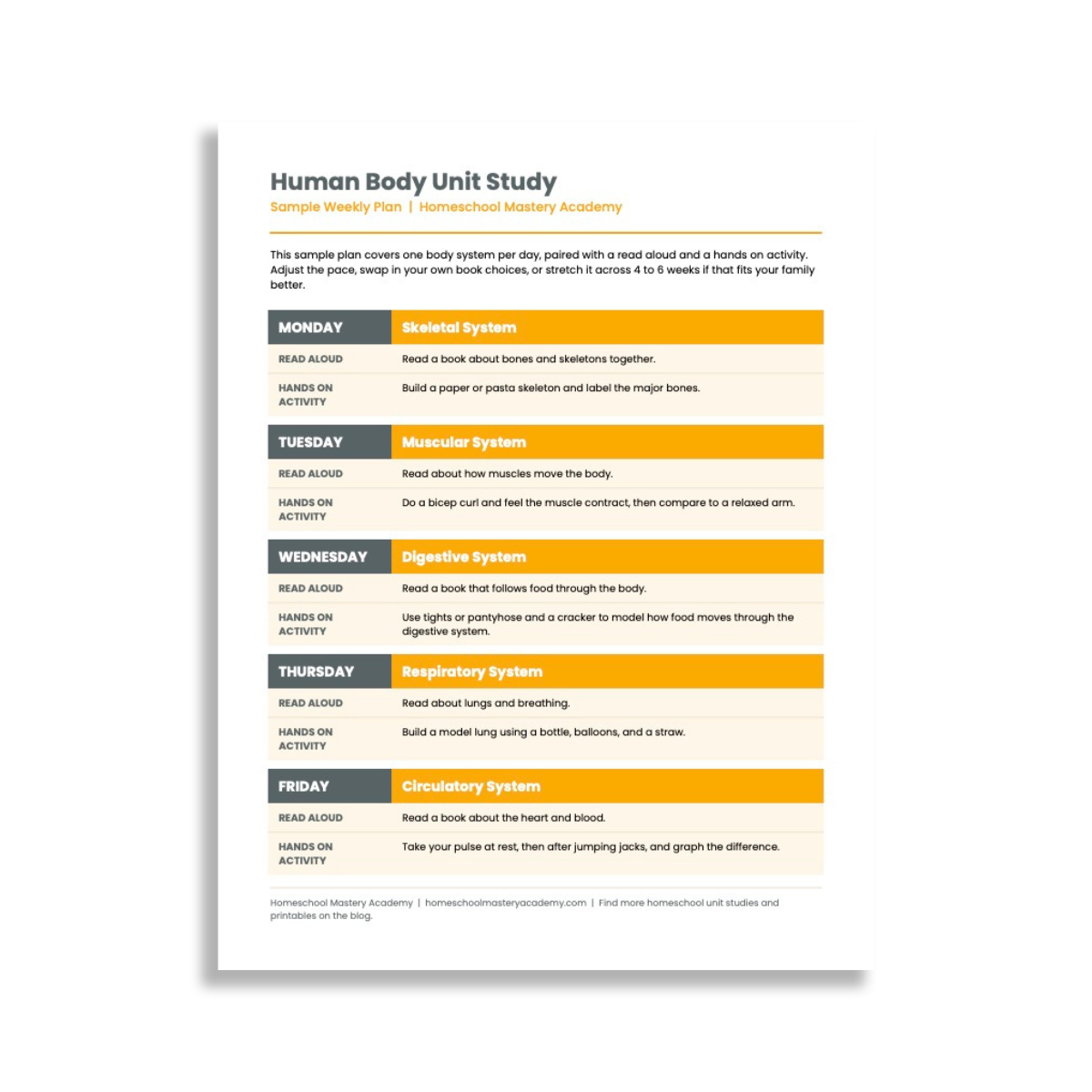
To help you get started, we put together a sample weekly plan you can download, print, and adapt for your own family. It lays out a suggested system to focus on each day, along with a paired read aloud and hands on activity, so you have a simple starting framework rather than a blank page.
Download the printable plan below, and feel free to share it on Pinterest or with other homeschool families who might find it useful.