
Homeschool Mastery Academy is dedicated to recommending quality resources to benefit homeschooling families. This blog contains and is monetized through sponsored posts and affiliate links. Please see our full disclosure policy for detailed information.
If there’s one thing we hear from homeschool families more than almost anything else, it’s that teaching multiple children at different ages at the same time is hard. Like, really hard. You’re trying to keep a kindergartner on task while your fourth grader needs help with fractions and your middle schooler is supposed to be writing an essay independently. It’s a lot, and if you’re feeling overwhelmed by it, you’re in good company.
Here’s the thing though. A lot of families find that once they stop trying to run their homeschool like a public school, something shifts. Teaching multiple ages together actually starts to feel like one of the best parts of homeschooling. Children learn from watching each other. Planning gets less complicated when you stop trying to do everything separately. And your home starts to feel more like an authentic homeschool.
There’s no formula that works for everyone. A family with four kids all under seven is going to run things very differently than a family with a kindergartner and a high schooler under the same roof. We want to share a practical look at the challenges, the real benefits, and the strategies that actually help you succeed.

How to Homeschool Multiple Ages at the Same Time
The biggest thing to understand about homeschooling multiple ages is that it calls for a completely different mindset than traditional schooling. In a classroom, a teacher is managing 25 or 30 kids who have nothing in common except their age. At home, your children already know each other. They share a history, a family culture, inside jokes, and a life together. That’s not a complication. That’s actually your biggest advantage.
Most of the struggle families face comes from trying to replicate a classroom model at home, running separate lessons for each child in every subject. Once you let go of that idea, things start to open up. Learning how to homeschool multiple ages effectively is really about figuring out where your children can learn together and where they need to be taught separately. That one shift can reduce stress, cut your planning time significantly, and honestly make your school days feel a lot more manageable.
Why Homeschooling Multiple Ages Can Be Challenging
Before we get into what works, it helps to just name what’s hard. These are real challenges, and most multi-age homeschool families deal with at least a few of them.
Managing Different Grade Levels at the Same Time
When you’ve got a third grader, a sixth grader, and a high schooler all sitting at the same table, it can genuinely feel like you’re running three separate schools out of one kitchen. Keeping track of where each child is, what they need to get done, and how to fit it all into one day takes real organization, and it doesn’t just happen on its own.
Balancing Individual Attention Between Children
Every child needs time with you directly, whether that’s for instruction, for checking in, or for working through something they’re stuck on. When you’ve got multiple children, that time has to stretch further. It’s one of the trickier parts of multi-age homeschooling to get right.
Meeting Different Learning Styles and Needs
One child reads independently for an hour without blinking. Another can’t absorb anything unless it’s hands-on. A third needs you sitting right next to them or nothing gets done. Getting all of those needs met at the same time, in the same space, takes flexibility and a willingness to keep adjusting as you figure out what works.
Coordinating Multiple Subjects and Schedules
Math at three different levels. Writing at three different stages. Reading at three different abilities. When every subject is running separately for every child, the planning alone can start to feel like a part-time job before you even get to the actual teaching.
Keeping Younger Children Engaged During Lessons
Little ones are unpredictable. Keeping a four-year-old occupied while you work through a lesson with an older child is genuinely one of the harder skills to develop, and most families figure it out through a lot of trial and error rather than any perfect system.
Finding Curriculum That Works Across Age Groups
A lot of curriculum is designed with a single grade level in mind, which means it doesn’t always stretch across ages the way a multi-age family needs. Finding resources that work for everyone, or knowing which subjects to combine and which to keep separate, takes some digging. The good news is there are more options built specifically for multi-age families than there used to be.
Avoiding Parent Burnout and Time Constraints
When you’re the teacher, the planner, the record keeper, and the parent all at once, homeschool burnout is a real risk. A multi-age setup that isn’t organized thoughtfully can pile on rather than simplify. Building a system that actually reduces your workload, rather than adding to it, is one of the most important things you can do.
Tracking Progress for Multiple Students
Keeping records for one child is doable. Keeping useful, accurate records for three or four children at different levels takes intention. It doesn’t have to be complicated, but it does need to be consistent.

What Are the Benefits of Children Learning Together
Honestly, this is where homeschooling multiple ages starts to get good. Because for all the juggling it takes, there are things that happen naturally in a multi-age homeschool that you just cannot replicate in a traditional classroom.
The most obvious one is that older children end up teaching younger ones, and that is not just helpful for the younger child.
There’s solid research behind the idea that teaching something is one of the best ways to truly lock in your own understanding of it. When your ten-year-old explains long division to your seven-year-old, both of them walk away better off.
Younger children also absorb far more than we give them credit for.
A six-year-old sitting in on a history discussion that’s aimed at a ten-year-old is quietly picking up vocabulary, context, and background knowledge that will resurface years later. It’s the kind of learning you can’t always measure, but it adds up over time.
When everyone is studying the same topic, something else changes too.
Dinner conversations get better.
Your kids actually have things to talk about with each other that aren’t just about screen time or who borrowed whose stuff. History, science, and literature become a shared family language instead of isolated school subjects that get forgotten by lunch.
There are real skill-building benefits on both ends of the age range.
Older children naturally step into leadership and communication roles when they’re learning alongside younger siblings. Younger children learn to participate in discussions that stretch them a little. Neither of those things happens the same way in a classroom full of kids the same age.
And from a practical standpoint, teaching one history lesson to everyone instead of three separate lessons saves you an enormous amount of time.
That alone is worth a lot on a busy school day. The shared memories that come out of those lessons, the books you read aloud together, the experiments you all do at the same table, those are the things kids tend to remember long after the content itself fades.

How to Homeschool Different Ages
These are the strategies that tend to make the biggest difference for multi-age families. They’re not rigid rules. They’re starting points worth trying.
Combine Subjects Like History, Science, Art, and Music
History, science, art, music, and read alouds don’t need to happen at different levels for different children. Everyone can be in the same lesson. The core content stays shared, and what you adjust is the output, meaning what each child produces or how they engage based on their age and ability.
If you’ve got four children all under seven, group up as many subjects as you possibly can. If your age range is wider, the same idea applies. A middle schooler and a third grader can absolutely study medieval history together. The older child writes a research summary. The younger one narrates or draws. Same content, different expectations.

Adjust Assignments Based on Age and Ability
Combining subjects doesn’t mean everyone does the same work. A shared science lesson might look like a simple verbal narration from a seven-year-old, a written paragraph from a ten-year-old, and a full written report from a fourteen-year-old. The lesson is shared. The output is not.
Use Read Alouds for Multi-Age Learning
Read alouds are one of the most underused tools in a homeschool family’s toolkit, and they’re incredibly effective across a wide range of ages. Reading aloud together builds vocabulary, comprehension, and a genuine love of books, all at the same time, for every child in the room. The discussion that follows tends to naturally differentiate itself by maturity and ability without you having to engineer it.
Encourage Independent Work for Older Children
Your older children’s ability to work independently is one of your greatest assets. The earlier you build that habit, and the more you protect structured independent work time for them, the more focused time you free up for the children who need you most.
Build Flexible Routines Instead of Strict Schedules
A rigid schedule falls apart fast in a multi-age homeschool. What holds up better is a flexible routine, a predictable flow to the day that gives everyone structure without locking you to the clock. That flexibility is what lets you follow a great discussion, spend more time where a child is struggling, or just handle the unpredictable parts of family life without the whole day unraveling. For more on this, see our post on how to create a homeschool schedule.
Focus on Shared Topics Rather Than Separate Lessons
Every time you can bring your children together around a shared topic instead of running separate lessons, you save time and energy. The subjects that usually need to be individualized are math, reading, and writing. Almost everything else is fair game for combining.
What to Do When You Have Babies and Toddlers in the Mix
If you’re homeschooling older children while also caring for a baby or toddler, you’re not just managing multiple grade levels, you’re managing a whole extra layer of unpredictability. The good news is that littles actually want to be part of what’s happening. They want to feel like they belong, and honestly that works completely in your favor.
One of the most effective things you can do is give your toddler or preschooler their own spot at the learning table. Not off in a corner, but right there with everyone else. Set them up with their own “school basket”, a dedicated collection of activities that feel special because they only come out during school time. Think crayons and a coloring book, play dough, wooden blocks, tangrams, stickers, or a simple puzzle. The key is rotation. Keeping a handful of activities in the basket and swapping them out regularly keeps the excitement alive and the interest going a lot longer than leaving the same things out every day.
When your toddler feels like they are doing school alongside their siblings rather than being managed off to the side, everyone benefits. If your little one feels included and the older children can focus, you get more uninterrupted teaching time than you’d expect.
Best Homeschool Curriculum for Multiple Ages
There’s no single perfect curriculum for multi-age homeschooling, and we’ll just say that upfront. What works depends on your children’s ages, your available time, the season your family is in, and whether combining or separating subjects makes sense for you right now. Some families thrive with a structured multi-age program. Others piece things together. Many do both.
What’s worth looking for are resources built around shared content that scales by age, rather than grade-level tracks that require separate materials for each child. Here are some that genuinely work that way:
Unit Studies
Naturally adaptable across ages. Everyone studies the same topic and expectations are adjusted by age. Here is a short list of unit studies that work for homeschooling multiple ages. And if you are ready to plan your own, our unit study planners cover a wide range of subjects and are designed to make planning for multiple ages simple and save you time.
The Homeschool Enrichment Collection
Our own done-for-you collection of themed enrichment activities covering classic literature, nature study, art, life skills, and more. Everything is flexible and adaptable for multiple ages, with zero prep required. It is a practical way to add engaging, hands-on learning to your homeschool week without adding more work to your plate.
Gather ‘Round Homeschool
A Christian, Charlotte Mason-inspired unit study curriculum built specifically for teaching multiple ages together. All children study the same topic at differentiated levels, covering core subjects from PreK through 12th grade, with math available separately.
Sonlight
A literature-based curriculum that divides subjects into two categories: Couch Subjects (history, Bible, literature, and science) which the whole family does together, and Table Subjects (math, language arts, spelling) which are done individually by each child. Works best when children are within about three years of each other, though families with wider age gaps can combine programs covering the same historical period.
The Mystery of History
A chronological world history curriculum written for the whole family. All ages study the same content with activity options that scale by level.
The Story of the World
A narrative history series that works well as a family read-aloud or spine. Covers ancient history through modern times and is a natural fit for mixed-age households.
Chalk Pastel (chalkpastel.com)
Art curriculum designed for all ages to work through together. No experience required, and every child works at their own level on the same lesson.
Literary Adventures for Kids
Online book clubs that work well for families with multiple students in elementary or middle school. If your children fall within that range, they can all join in on the same book club together, making it a shared experience rather than a separate assignment for each child.
Homeschool Nature Study
Built around the Handbook of Nature Study and weekly Outdoor Hour Challenges, this membership works for all ages at the same time. Children from preschool through high school can participate in the same nature study activities, with the depth of learning naturally adjusting by age. A good fit for families who want to get outside together as part of their regular school day.
Simply Charlotte Mason
A Charlotte Mason approach that is well suited for family-style learning. Most history and Bible study is done together as a family using a six-year history cycle, and older students simply receive additional reading and assignments at their level.
A Gentle Feast
A structured Charlotte Mason curriculum that uses loop scheduling to keep the whole family moving through the same historical time periods together, regardless of age.
The Peaceful Press
Literature-rich unit studies built around living books that naturally include multiple ages. A good fit for families who want beautiful, story-driven learning without rigid grade divisions.
For subjects that need to be individualized, math and language arts especially, choose based on each child’s actual level, not their age or grade.
Homeschool Schedule for Multiple Ages
To help you get started, we put together a free multi-age homeschool schedule you can download and use right away. It includes three sample schedules and a blank template you can fill in for your own family.
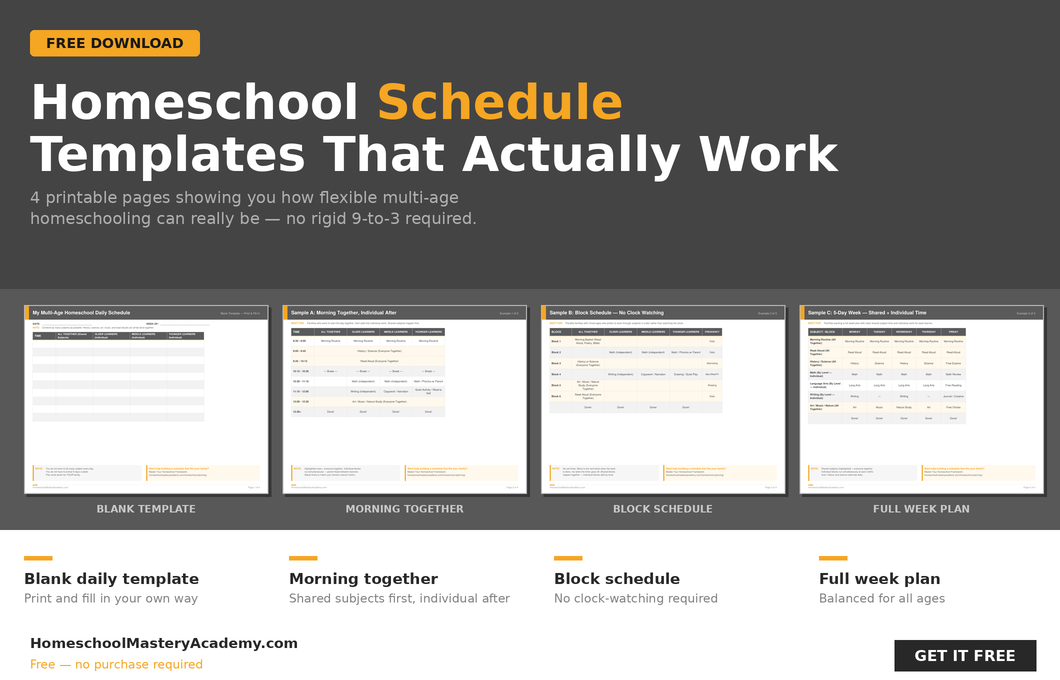
A few things to keep in mind as you build yours out:
- Start with your shared subjects and build everything else around them.
- Put your most focused work in the morning when children are freshest.
- Use older children’s independent work time to give one-on-one attention to younger learners.
- Build in free time. Unstructured play and exploration supports learning in ways that a packed schedule simply can’t.
- Keep it flexible. A routine with a predictable flow will hold up far better than a schedule tied to the clock.
For more on structuring the homeschool day, see our post on how to create a homeschool schedule.
Homeschooling multiple children at different ages takes some figuring out, and there’s no getting around that. But most families find that once they stop trying to run separate schools under one roof and start leaning into what makes home education genuinely different, things start to click. The goal isn’t a perfectly running school. It’s a home where children are learning, growing, and doing it alongside each other. That looks different for every family, and that’s exactly as it should be.
