Homeschool Mastery Academy is dedicated to recommending quality resources to benefit homeschooling families. This blog contains and is monetized through sponsored posts and affiliate links. Please see our full disclosure policy for detailed information.
Printable STEM activities are one of the easiest ways to bring hands-on learning into a homeschool day without a big time investment or an expensive kit that ends up unused on a shelf. They’re a practical way to bring science, technology, engineering, and mathematics to life through hands-on exploration, creative problem solving, and real experimentation your kids can actually touch. In our own homeschool, free printables and simple STEM activities have made it so much easier to work STEM into our week, even on the days that don’t go as planned.
Printable STEM Activities for Homeschool
Below you’ll find a full list of STEM activities for homeschool students, whether you have preschoolers just starting to explore, elementary school kids ready for structured lesson plans, or older homeschoolers who want something more independent. Each one takes a hands-on approach to science technology engineering and mathematics, so kids are doing instead of just reading. Some lean toward a science activity and hands-on experimentation, others focus on engineering and building, and a few bring in basic coding or technology concepts. You’ll also find a few tips for working stem subjects into your homeschool curriculum, even if this is new territory for your family.

What Are STEM Activities
STEM stands for science, technology, engineering, and mathematics, and STEM activities bring these subjects together through hands-on learning instead of teaching them separately out of a workbook. This hands-on approach is really at the heart of good stem education, kids learn by doing rather than just reading about it. Instead of memorizing facts, kids explore, test, build, and problem solve their way to an answer. It’s the kind of learning that builds curiosity, creative problem solving, and the confidence that comes from figuring something out on your own, skills that carry well past a single science technology engineering and math lesson.
Why STEM Matters in Homeschool
STEM doesn’t have to feel like an extra subject squeezed into an already full day. Building stem skills early pays off in ways that go beyond a single lesson, here’s why it’s worth making room for.
It Builds Creative Problem Solving Skills
There’s rarely one obvious right answer in a STEM activity, so kids get practice looking at a problem from a few different angles. That habit sticks around long after the activity itself is done.
It Makes Learning Feel Like Play
Building, testing, and experimenting rarely feel like schoolwork to a kid, even though real learning is happening the entire time.
It Connects to Real Life
Bridges, weather, plants, and machines are already all around your kids. STEM just gives language and structure to things they’re already curious about.
It Works for Multiple Ages at Once
A lot of printable STEM activities flex up or down depending on the age of the child using them, which makes them a natural fit if you’re teaching more than one grade level at a time.
It Builds Confidence in STEM Subjects Early
Kids who get comfortable with hands-on science and math early tend to carry that confidence with them as the material gets harder later on.

How To Introduce STEM Into Homeschool
You don’t need a science lab or a subscription box to bring stem into your homeschool. Here are a few practical ways to get started.
Start With What You Already Have
Craft sticks, paper, tape, and things from your kitchen can carry an entire stem project. Save the shopping list for later and start with what’s already in your house.
Use Free Printables Before Buying Kits
Free STEM printables let you try an activity before you invest in a kit or curriculum, which is a low pressure way to see what your kids actually enjoy. If you do want to go further once you know what sticks, we’ve shared our experience with a hands-on STEM subscription from MEL Science that’s worked well for us.
Keep Activities Short and Simple
A single simple STEM activity, done well, teaches more than an ambitious one that gets abandoned halfway through. Short and doable beats elaborate and overwhelming almost every time.
Let Kids Lead the Exploration
Try to resist the urge to correct every step. Part of what makes STEM valuable is letting kids test an idea, watch it not work, and try again on their own.
Explore STEM Through Stories and Biographies
STEM doesn’t only happen at a table with supplies. Reading about the people behind the discoveries builds the same curiosity. Our Notable STEM Figures pack pairs biography with hands-on activities, and our Women in STEM post is a great companion if you want to highlight some often overlooked contributors.
Add One STEM Project a Week
You don’t need to overhaul your homeschool curriculum to integrate STEM. Adding one activity a week is enough to build the habit without adding pressure. If you’re looking to build out a more hands-on STEM shelf over time, our stem gift ideas post is a good place to start.

25 Printable STEM Activities for Homeschool
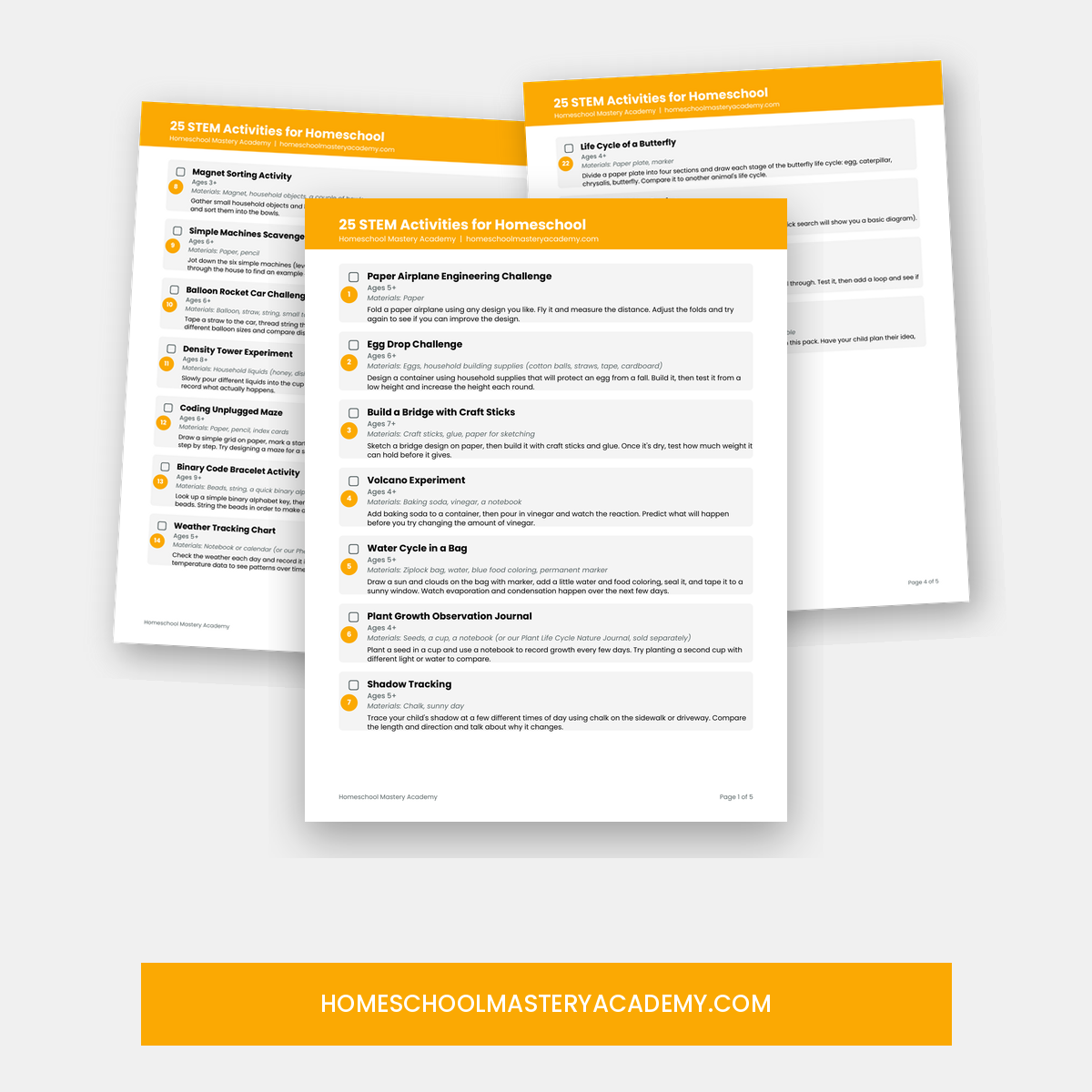
Here are 25 STEM activities you can use with students learning at home right now, loosely organized from younger to older, though most work well in either direction. Most use simple household items, so you can get started without buying or printing anything special.
1. Paper Airplane Engineering Challenge
All you need is paper. Fold a paper airplane using any design you like, fly it, and measure the distance with a tape measure. Ages 5 and up. Adjust the folds and try again to see if you can improve the design.
2. Egg Drop Challenge
Grab some eggs and whatever building supplies you have around the house, cotton balls, straws, tape, cardboard. Best for ages 6 and up. Design a container that will protect the egg from a fall, then test it from a low height and increase the height each round.
3. Build a Bridge with Craft Sticks
Craft sticks and glue go a long way here. Ages 7 and up will get the most out of sketching a design on paper first, then building it and testing how much weight it can hold before it gives. If bridge and structure builds are a hit in your house, our STEM Building Challenges pack has a whole set of similar projects to keep going with.
4. Volcano Experiment
Baking soda and vinegar make this a homeschool classic for good reason. It’s an approachable way to introduce chemical reactions to kids as young as 4. Have your child predict what will happen before you change up the ratio of ingredients. For more ideas along these lines, our science experiments for kids at home post has several more to try.
5. Water Cycle in a Bag
A ziplock bag, a little water, blue food coloring, and a permanent marker are all you need. Draw a sun and clouds on the bag, add the water, seal it, and tape it to a sunny window. Works well for ages 5 and up. Watch evaporation and condensation happen right in front of you over the next few days.
6. Plant Growth Observation Journal
Seeds, a cup, and a notebook turn watching a plant grow into a real observation exercise. Good for ages 4 and up. If you’d rather use a ready-made version, our Plant Life Cycle Nature Journal covers this beautifully, with space for sketching, labeling, and tracking what plants need to grow.
7. Shadow Tracking
All you need is chalk and a sunny day. Suited for ages 5 and up. Trace your child’s shadow at a few different times of day and compare the length and direction, then talk through why it changes. If astronomy ends up being a favorite, our Solar Eclipse STEM Activities Pack is a natural next step.
8. Magnet Sorting Activity
A magnet, a handful of household objects, and a couple of bowls make a great early introduction to magnetism and classification for kids as young as 3. Have your child predict before testing each object for the best results.
9. Simple Machines Scavenger Hunt
With just paper and a pencil, kids ages 6 and up can jot down the six simple machines and hunt through the house for an example of each. Sketching and labeling what they find helps the concept stick. For more on the people who invented the machines and tools we use every day, our Inventors & Inventions Activities pack builds on this nicely.
10. Balloon Rocket Car Challenge
A balloon, a straw, some string, and a small car are all it takes to introduce force and motion in a way that gets kids moving too. Ages 6 and up. Try different balloon sizes and compare how far the car travels.
11. Density Tower Experiment
Household liquids like honey, dish soap, water, and oil make density visible in a way that’s hard to forget. Best suited for ages 8 and up. Have your child predict the layer order before pouring for an extra challenge.
12. Coding Unplugged Maze
Draw a simple grid on paper and mark a start and end point. Ages 6 and up can use arrow-labeled index cards to plan a path through the maze step by step. Let your child design one of their own for a sibling to solve.
13. Binary Code Bracelet Activity
Beads, string, and a quick binary alphabet lookup turn basic computer science into a craft project kids ages 9 and up genuinely enjoy. Try encoding a name or a short word once they’ve got the hang of it.
14. Weather Tracking Chart
A notebook or calendar builds observation skills and introduces basic meteorology for ages 5 and up. Our Phenology Wheel Nature Journal is a nice printable option if you want something ready to go. Graphing a month of temperature data afterward turns it into a small math project too.
15. Bird Beak Adaptation Lab
Household tools like tweezers, spoons, and clothespins stand in for different bird beaks in this hands-on comparison activity, best for ages 7 and up. Have your child record which tool worked best for which item.
16. Marble Run Design Challenge
Cardboard tubes and tape are all you need to reinforce engineering design and gravity with kids ages 6 and up. Time the marble and see if your child can beat their own record on a second attempt.
17. Tangram Puzzle Set
Cut a square of cardstock into seven geometric pieces to make your own tangram set, or grab our ready-made Printable Tangrams: Four Seasons Puzzle Mats. Ages 5 and up will enjoy recreating pictures or designing an original one using every piece.
18. Geometry Shape Hunt
Jot down a quick list of shapes and walk through the house or yard looking for real objects that match each one. Good for ages 4 and up. Sorting what they find by number of sides adds a nice extra step.
19. Fraction Pizza Activity
A paper plate, a marker, and scissors make fractions visual and hands-on for ages 6 and up, or you can use our ready-to-go Pizza Fraction Printables. Build a few word problems using the pieces once your child is comfortable with the basics.
20. Measurement Scavenger Hunt
A ruler or tape measure and a notebook build practical, everyday measurement skills for ages 5 and up. Comparing estimated versus actual measurements is a good gut check for older kids.
21. Rock and Mineral Study
Collect a few rocks from outside and use a library book or trusted online guide to identify them by color, texture, and shape. Good for ages 6 and up. Our Rock Activity Pack is a ready-made option that includes a rock formation guide, a rock cycle chart, and a journal sheet to log what your child finds.
22. Life Cycle of a Butterfly
A paper plate and a marker introduce life cycles and sequencing for ages 4 and up. Divide the plate into four sections and draw each stage, egg, caterpillar, chrysalis, butterfly, then compare it to another animal’s life cycle.
23. Circuit Building Basics
A battery, some wire, and a small bulb introduce basic electricity and circuits for ages 8 and up. Once the basics click, try adding a switch to the circuit.
24. Straw Roller Coaster Challenge
Flexible straws and tape reinforce engineering and gravity concepts for kids ages 7 and up as they build their own coaster for a marble. See if it still makes it through once you add a loop.
25. STEM Reflection Journal
Use a notebook, or the journal pages in our free printable below, to have your child plan their idea, build it, test it, and record what they’d improve next time. This works alongside any activity on this list, and is really the engineering design process behind everything here.
STEM doesn’t have to stop at science and engineering either. If your kids enjoy the creative side of things, our STEAM Storytelling Prompts blend writing and imagination with STEM concepts, which is a nice way to round things out for kids who lean more toward language arts.
How To Get the Most Out of Printable STEM Activities for Homeschool
- Encourage curiosity over correctness. Ask what your child noticed instead of whether they got the right answer.
- Allow trial and error. A failed first attempt is often the most valuable part of a stem project.
- Ask open ended questions. Try “what do you think will happen” instead of explaining the outcome ahead of time.
- Revisit activities to deepen learning. Trying an activity again a few months later often shows how much your child has grown.
- Keep a folder of free STEM printables. Having a few ready to go makes it easier to fit one in on a busy week.